
What a GPS running watch actually does for your training
A GPS watch is one of the most impactful pieces of running gear you can own — not because of the technology itself, but because of what it reveals. Runners who track their data consistently make better decisions about pace, recovery, and training load. They know when they’re running too fast on easy days, when their heart rate is elevated before they feel tired, and whether their fitness is actually improving week over week.
The market has expanded dramatically. There are now genuinely excellent running watches at every price point from $150 to $1,200 — and the gap between budget and premium has narrowed considerably. This guide helps you find the right watch for where you are in your running right now, without overspending on features you won’t use.


Last update on 2026-09-20 / Affiliate links / Images from Amazon Product Advertising API
Key features to understand before you buy
GPS accuracy is the most important spec and the hardest to evaluate from a product page. Multi-band or dual-frequency GPS — which uses signals from multiple satellite systems simultaneously — is significantly more accurate than single-band GPS, especially in dense urban environments, forests, and canyon-like streets. If you run in cities or on technical trails, dual-frequency GPS is worth the upgrade.
Battery life determines how useful the watch is across different types of training. A watch with 8 hours of GPS battery is fine for a 5K runner but useless for a marathoner or trail runner doing 4+ hour long runs. Check the GPS battery spec specifically — smartwatch battery life (measured in days) is very different from active GPS battery life (measured in hours).
Heart rate monitoring is built into virtually every modern running watch. Wrist-based HR is convenient but less accurate than a chest strap, particularly during high-intensity intervals when wrist movement creates noise in the sensor reading. For most everyday training the wrist sensor is good enough. For serious interval work or lactate threshold testing, a chest strap adds meaningful accuracy.
Training load and recovery metrics — features like VO2 max estimates, training status, body battery, and daily suggested workouts — are among the most useful additions to modern watches. They help runners avoid overtraining and make rest days feel deliberate rather than lazy. These features are now available on mid-range watches, not just premium models.
Display type — AMOLED screens are bright, sharp, and easy to read at a glance. MIP (memory-in-pixel) displays are dimmer but dramatically more power-efficient, which is why endurance-focused watches often use them. For everyday runners, AMOLED is the better experience. For ultrarunners or anyone doing multi-day events, MIP’s battery advantage is significant.
Best GPS watches for beginner runners
New runners don’t need advanced metrics — they need accurate GPS, a clear display, comfortable wear, and enough battery to cover their longest run. Overcomplicated watches create friction that gets in the way of the habit you’re trying to build.
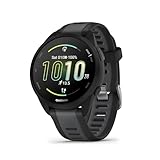
The Garmin Forerunner 165 is the most recommended beginner running watch on the market. It has a bright AMOLED display, accurate GPS, Garmin Coach integration for structured training plans, and battery life that handles up to 31 hours in GPS mode. It’s lightweight, intuitive to set up, and doesn’t overwhelm you with data you’re not ready to use yet. It also supports Spotify and music storage on the watch itself, which removes the need to carry your phone on runs.
The COROS Pace 4 is the other strong contender at the beginner-to-intermediate level. It’s lighter than the Forerunner 165, has exceptional GPS accuracy, and offers battery life that goes well beyond what most new runners will ever need. The COROS app is less polished than Garmin’s, but the core running experience is excellent. For runners who want accuracy and simplicity without the Garmin ecosystem, the Pace 4 is hard to beat.

Last update on 2026-09-20 / Affiliate links / Images from Amazon Product Advertising API
Best GPS watches for intermediate runners
Intermediate runners — those training consistently, targeting race times, or building toward their first half marathon or marathon — benefit from more advanced training metrics. Recovery tracking, training load analysis, and structured workout guidance become genuinely useful at this stage rather than just interesting to look at.
The Garmin Forerunner 265 sits at the sweet spot for this group. It has dual-band GPS for improved accuracy, an AMOLED display, and Garmin’s full suite of training intelligence including daily suggested workouts, training readiness, and PacePro for race-day pacing strategy. Battery life runs around 13 days in smartwatch mode and 24 hours in GPS mode — enough for any standard training week without constant charging.
The COROS Pace 3 is the value alternative at a lower price point. It has outstanding battery life for its size — up to 38 hours in GPS mode — which makes it an excellent choice for runners who do long runs regularly and don’t want to be caught with a dead watch at mile 18. GPS accuracy is consistently praised across reviews, and the training analytics cover all the fundamentals without the premium price.


Last update on 2026-09-20 / Affiliate links / Images from Amazon Product Advertising API


Last update on 2026-09-20 / Affiliate links / Images from Amazon Product Advertising API
Best GPS watches for serious and advanced runners
Advanced runners who are chasing personal records, training with structured plans, or covering high weekly mileage need a watch that keeps up with the data demands of serious training.
The Garmin Forerunner 970 is currently the most feature-complete running watch available. It has dual-frequency GPS, Garmin’s Elevate 5 heart rate sensor, real-time stamina tracking, lactate threshold estimation, heat and altitude acclimation guidance, and a sapphire glass display. The feature set is genuinely impressive — it’s the watch you buy when you’ve outgrown everything below it and want nothing left out.
The Garmin Fenix 8 takes everything in the Forerunner line and adds multi-sport capability, topographic maps, a built-in LED flashlight, dive-rated water resistance, and solar charging options. For runners who also cycle, swim, ski, or hike, the Fenix 8 covers every activity without compromise. It’s heavier and bulkier than the Forerunner — which matters during racing — but for training use it’s the most capable watch Garmin makes.
Last update on 2026-09-20 / Affiliate links / Images from Amazon Product Advertising API
GPS watches vs Apple Watch — which is better for running?
The Apple Watch Ultra 3 is a capable running watch, particularly for iPhone users who want one device for everything — payments, notifications, Siri, and running tracking. GPS accuracy is good, the display is excellent, and integration with the Apple Health ecosystem is seamless.
Where the Apple Watch falls short for dedicated runners is battery life and running-specific metrics. Apple Watch Series models last one to two days between charges, which requires daily charging — fine for casual runners, disruptive for marathoners and trail runners doing multi-hour efforts. Training load analysis, recovery guidance, and advanced running dynamics are also less sophisticated than Garmin’s or COROS’s equivalents at the same price point.
The practical answer: if you’re an iPhone user who runs 3–4 times per week for fitness and doesn’t race, the Apple Watch is a perfectly good choice. If running is a serious part of your life and you want the best available training data, a dedicated running watch from Garmin or COROS is the better investment.


Last update on 2026-09-20 / Affiliate links / Images from Amazon Product Advertising API
What to look for in a running watch — quick checklist
- GPS mode battery life — should comfortably exceed your longest planned run with margin to spare
- Dual-frequency GPS — worth having at any price point above $200 for improved accuracy
- Heart rate monitor — built-in wrist HR is standard; chest strap support matters if you do serious interval training
- Training load and recovery metrics — especially useful for runners building mileage and managing injury risk
- Weight — lighter watches are less noticeable during long runs; check the gram weight, not just the case size
- Water resistance — minimum 5ATM for runners; this covers rain, sweat, and swimming
- Ecosystem compatibility — Garmin Connect, COROS app, and Suunto app each have different strengths. Check which integrates with the platforms you already use (Strava, TrainingPeaks, etc.)
Getting more from your running data
A GPS watch gives you excellent data about what happened on your run. What it can’t provide is a structured program that tells you what to do with that data — how to build mileage safely, when to push and when to recover, and how to train specifically for your goals. Our Dynamic Runner Club review covers one of the most talked-about running training apps for everyday runners who want to improve with structure and guidance, not just more data.