
Why foam rolling belongs in every runner’s routine
Most running injuries don’t arrive suddenly — they build quietly over weeks of accumulated tightness that never quite gets addressed. Tight hip flexors shorten your stride gradually. IT band tension pulls at the knee in ways that feel like random discomfort until they don’t. Calf adhesions reduce ankle mobility just enough to overload structures further up the chain. By the time something hurts enough to stop your training, the problem has been developing for months.
Foam rolling addresses this at the source. Used consistently before and after runs, it maintains the tissue quality that keeps you training — not as an emergency intervention when something goes wrong, but as a daily habit that prevents the cascade of compensations that lead to injury in the first place. Ten minutes of foam rolling after a run is one of the highest return-on-investment recovery habits available to runners at any level.


Last update on 2026-09-20 / Affiliate links / Images from Amazon Product Advertising API
Foam roller types — what the differences actually mean
The market is full of options that look similar but behave very differently. Understanding the key variables helps you buy the right tool rather than the most popular one.
Density is the most important variable. Soft rollers provide gentle pressure — good for beginners, post-race recovery, or acutely sore muscles. Medium density hits the sweet spot for most runners: firm enough to reach deeper fascial layers but not so hard that your muscles guard against the pressure (which eliminates most of the benefit). Extra-firm or black rollers are for experienced users with adapted tissue — they’re not more effective by default, just more intense. If you tense up while rolling, the roller is too firm for where you are right now.
Texture determines how targeted the pressure is. Smooth rollers deliver even, distributed pressure across the full contact area — ideal for large muscle groups and beginners. Textured rollers — grid patterns, ridges, or knobs — concentrate pressure in specific zones to mimic the targeted work of a massage therapist’s hands. For runners dealing with IT band tightness or chronic calf tension, a textured surface reaches deeper than a smooth one.
Length affects which muscles you can effectively target. A 36-inch full-length roller handles the back, quads, and hamstrings comfortably. A 13-inch short roller is more portable and easier to maneuver on smaller muscle groups like calves and IT bands. Most serious runners end up owning both — a full-length roller for general recovery and a shorter one for travel and targeted work.
Vibrating rollers add mechanical vibration to the rolling motion, which research suggests increases muscle relaxation and blood flow beyond what static rolling achieves. They’re effective — the Hyperice Vyper is the best-known example — but at 3–4x the price of a standard roller, they’re a worthwhile upgrade rather than a necessary starting point.
Best foam rollers for general running recovery
The TriggerPoint Grid is the most recommended foam roller for runners across virtually every running publication and physical therapist recommendation list. Its multi-density grid surface mimics the varying pressure of a massage therapist’s hands — flat zones, channel zones, and raised zones — in a compact 13-inch format that handles calves, IT bands, quads, and hamstrings with equal effectiveness. The hollow core maintains its shape over years of use, unlike solid foam rollers that compress and flatten. It’s the benchmark that other textured rollers are measured against.
For a full-length option, the Amazon Basics 36-inch high-density roller is the practical choice for home use. It covers the entire back in one pass — something shorter rollers can’t do — and handles large muscle groups like quads and hamstrings with consistent pressure. At well under $30 it’s genuinely excellent value for what it does.


Last update on 2026-09-20 / Affiliate links / Images from Amazon Product Advertising API


Last update on 2026-09-20 / Affiliate links / Images from Amazon Product Advertising API
Best foam rollers for IT band pain
IT band issues are among the most common running injuries, and foam rolling is one of the most effective management tools — but only if you use the right technique and the right tool. The IT band itself is a dense fibrous band that doesn’t respond well to direct aggressive rolling. The goal is to release the surrounding tissue — the TFL at the hip and the lateral quad — that pulls on the IT band rather than trying to roll the band itself directly.
A medium-density textured roller is the right choice here. The RumbleRoller — available in standard and extra-firm — uses firm, rounded bumps that compress and release tissue in a way that smooth rollers can’t replicate. It’s more aggressive than most rollers and not recommended as a first foam roller, but for runners with chronic IT band issues who have already been rolling for a while, it produces noticeably better results than standard textured rollers.
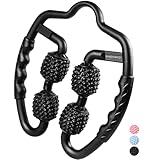
A massage roller stick is worth pairing with your foam roller for IT band work. The stick allows you to apply direct, controlled pressure along the length of the IT band and lateral quad while seated — no floor required — and gives you precise control over where and how hard you’re pressing. Most physical therapists recommend runners own both a roller and a stick for comprehensive lower body maintenance.
Last update on 2026-09-20 / Affiliate links / Images from Amazon Product Advertising API


Last update on 2026-09-20 / Affiliate links / Images from Amazon Product Advertising API
Best vibrating foam rollers
Vibrating foam rollers add a meaningful upgrade over standard rolling for runners who are serious about recovery. The vibration helps override the protective muscle tension that can make standard rolling uncomfortable — muscles relax more readily against a vibrating surface, which lets the roller reach deeper tissue more effectively.
The Hyperice Vyper 2.0 is the category leader. Three vibration settings, a rechargeable battery, and a textured surface make it the most versatile vibrating roller available. It’s a significant investment at around $150–$180, but for runners who roll daily and have plateaued on standard rollers, the upgrade is worthwhile.
For a more affordable vibrating option, several brands offer single-speed vibrating rollers in the $40–$60 range that provide the core benefit without the premium price. The vibration intensity is lower than the Hyperice, but for runners who haven’t used a vibrating roller before, it’s a reasonable entry point.


Last update on 2026-09-21 / Affiliate links / Images from Amazon Product Advertising API
Foam rolling for runners — key muscle groups and timing
Knowing what to roll and when makes the difference between foam rolling that helps and foam rolling that does nothing. Here are the areas that matter most for runners:
- Calves — the most chronically tight muscle group in distance runners. Roll from the ankle to just below the knee, pausing on tight spots. Cross one leg over the other for increased pressure.
- IT band and lateral quad — lie on your side with the roller under your outer thigh. Move slowly from hip to knee. Pause on tender areas rather than rolling aggressively through them.
- Quads — lie face down with the roller under your thighs. Move from hip to just above the knee. This is one of the most impactful areas for runners with knee pain.
- Hamstrings — sit on the roller with it under your thighs. Use your hands to lift your bodyweight and control pressure. Cross one leg over the other to increase intensity on one side.
- Glutes and piriformis — sit on the roller with it under one glute. Cross your ankle over the opposite knee to target the piriformis specifically. This area is chronically neglected and directly affects hip mobility and running mechanics.
- Upper back and thoracic spine — lie with the roller perpendicular to your spine, hands behind your head. Move from the mid-back to the shoulder blades. Avoid rolling the lower back directly.
Timing: Before a run, keep rolling light and brief — 20–30 seconds per area with minimal pressure to increase blood flow without fatiguing the muscle. After a run, spend 60–90 seconds on each area, pausing on tight spots and breathing through the discomfort rather than tensing against it.
Complete runner’s recovery kit
A foam roller is the foundation, but a complete recovery kit covers the muscle groups a roller can’t reach effectively. A massage ball for the glutes, plantar fascia, and shoulders; a roller stick for calves and IT bands; and a stretching resistance band for hip flexor and hamstring work covers virtually everything a runner needs between sessions.


Last update on 2026-09-21 / Affiliate links / Images from Amazon Product Advertising API
Recovery tools and structured training work together
Foam rolling addresses the physical side of recovery — tissue quality, mobility, and soreness management. The other side is training structure: knowing when to push, when to pull back, and how to build mileage without accumulating the kind of load that leads to injury regardless of how well you roll. Our Dynamic Runner Club review covers one of the most popular running training programs for everyday runners who want both structure and accountability in their training.