
Why a rangefinder belongs in every golf bag
Guessing yardages is one of the easiest ways to add strokes. A golfer who knows they’re 157 yards to the flag makes a confident club selection. A golfer who thinks they’re somewhere between 150 and 165 hedges — and hedging leads to half-committed swings. A rangefinder removes that uncertainty entirely and costs you nothing in terms of pace of play.
The good news is that rangefinders have come down significantly in price while going up dramatically in capability. There are genuinely useful options at every budget from under $100 to premium models above $500. This guide cuts through the marketing and tells you what actually matters, what’s worth paying for, and which features are nice-to-have versus essential.
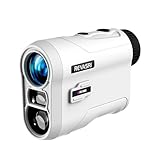


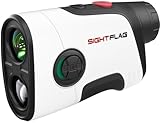
Last update on 2026-04-06 / Affiliate links / Images from Amazon Product Advertising API
Laser rangefinder vs GPS — which is right for you
This is the first decision to make before spending a dollar.
Laser rangefinders use a beam of light to measure the exact distance to whatever you point at — the flagstick, a bunker, a tree. They’re fast, accurate to within a yard, and don’t require course mapping or a subscription. The limitation is that you need a clear line of sight to your target. You also need to hold the device steady enough to lock onto the flag, which some golfers find tricky at longer distances.
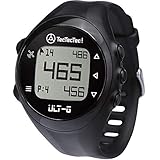
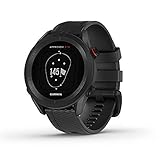
GPS devices — watches, handhelds, or phone apps — show pre-loaded distances to the front, center, and back of every green, plus hazards and layup points, without you having to aim at anything. They’re useful for course management and especially good for golfers who play quickly and want distances without stopping to range. The limitation is accuracy — GPS gives you distance to a fixed point on the green, not the actual pin position, so you can be 5–15 yards off depending on where the flag is cut that day.
Hybrid devices combine both — GPS mapping overlaid through the viewfinder of a laser rangefinder. They’re the most feature-rich option and the most expensive. Garmin’s Approach Z82 is the best-known example.
For most golfers, a laser rangefinder is the better choice. The pin-specific accuracy makes a real difference on approach shots, and modern devices lock onto flags quickly and reliably. GPS watches are a great companion for course management, but as a primary distance tool the laser wins.
Slope adjustment — useful but check the rules
Slope adjustment calculates the effective playing distance after accounting for elevation change. A 150-yard shot uphill to an elevated green might play like 162 yards — slope tells you that. It’s genuinely useful for practice rounds and recreational play.
The important caveat: slope mode is not permitted in stroke play competitions under USGA and R&A rules. Any rangefinder you use in a tournament must have slope disabled. Quality rangefinders handle this with a physical toggle switch — slope on for practice, slope off for competition. Make sure any rangefinder you buy has this feature if you play in any competitive format.
For purely recreational golfers who never enter competitions, a slope-only rangefinder without a toggle is fine and usually cheaper. For anyone who plays in club competitions, a toggle is non-negotiable.
Key features to look for
- Pin-lock vibration — the rangefinder vibrates when it locks onto the flagstick rather than a background object. This confirmation is essential on courses where trees or hills sit behind greens. Every decent modern rangefinder includes this — if a model doesn’t, pass on it.
- Magnification — 6x is the standard and perfectly adequate. Higher magnification can make it harder to stabilize the device at longer distances.
- Display type — some rangefinders offer switchable red/black displays for different lighting conditions. Useful but not essential.
- Weather resistance — at minimum, look for water resistance. Full waterproofing (IPX7 rated) is worth paying for if you play in wet climates.
- Magnetic cart mount — a magnet built into the case that sticks to your cart rail. Extremely convenient and now standard on mid-range and above models.
- Battery life — most laser rangefinders use a CR2 battery that lasts 1–2 rounds, or a rechargeable battery that lasts multiple rounds per charge. Rechargeable is more convenient but requires remembering to charge.
Best budget golf rangefinders — under $150
Budget rangefinders have improved dramatically. You no longer have to sacrifice accuracy or pin-lock reliability to stay under $150. The Blue Tees Series 3 and Callaway 300 Pro are the two most recommended options in this range — both offer slope adjustment, pin-lock vibration, and reliable accuracy. The Callaway has slightly better optics; the Blue Tees adds a magnetic mount and backs it with a lifetime warranty.
For golfers on the tightest budget, options around the $40–$60 mark on Amazon include slope adjustment and flag-lock confirmation — more than enough for a beginner who wants accurate distances without a significant investment.
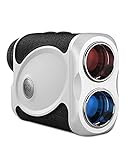

Last update on 2026-04-06 / Affiliate links / Images from Amazon Product Advertising API
Best mid-range golf rangefinders — $150 to $300
This is the sweet spot for most serious recreational golfers. The Shot Scope Pro ZR consistently earns strong reviews at the $300 price point — slope adjustment, dual display, and free GPS aerial maps via the Shot Scope app make it exceptional value. The Garmin Approach Z30 is the other standout in this range, particularly for golfers who already use a Garmin GPS watch — the two devices sync to display laser distances alongside GPS data simultaneously.
At this price level you should expect: fast and reliable pin-lock, slope with tournament-legal toggle, magnetic cart mount, weather resistance, and clear 6x optics. If a rangefinder at this price is missing any of these, there are better options.


Last update on 2026-04-06 / Affiliate links / Images from Amazon Product Advertising API
Best premium golf rangefinders — $300 and above
The Bushnell Pro X3+ LINK is the most widely recommended premium rangefinder on the market. It takes slope adjustment further than competitors by factoring in temperature, altitude, and barometric pressure — not just elevation — to calculate a true playing distance. The LINK feature connects to the Bushnell app and, if you use a compatible Bushnell or Foresight launch monitor, will recommend which club to hit based on your actual tracked distances. At $500+, it’s a serious investment — but for golfers who play regularly and want the most accurate distance information available, nothing else comes close.
The Garmin Approach Z82 is the premium hybrid option — full GPS course mapping overlaid through the viewfinder, combined with laser accuracy. If you currently carry both a GPS watch and a rangefinder and want to consolidate, this is the device that replaces both.

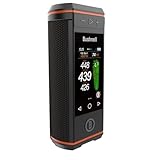

Last update on 2026-04-06 / Affiliate links / Images from Amazon Product Advertising API
Rangefinder vs GPS watch — do you need both?
Many golfers end up with both, and there’s a good argument for the combination. A GPS watch shows you front/center/back distances at a glance without pulling anything out of your pocket — useful when walking to your ball or planning your tee shot on a blind hole. A rangefinder gives you pin-specific accuracy on approach shots. Used together, they cover every distance scenario on the course.
If budget forces a choice, the rangefinder is more directly useful for scoring. Knowing the exact distance to the pin on every approach shot has a more immediate impact on club selection than knowing the distance to the center of a green you can already see.

Last update on 2026-04-06 / Affiliate links / Images from Amazon Product Advertising API
Getting the most out of your rangefinder
A rangefinder tells you how far you are. What it can’t tell you is which club to hit, how to execute the shot, or how to build the swing consistency that turns good distance information into lower scores. That’s where a structured training program makes the difference. Our Dynamic Golfer review covers one of the most popular golf-specific training apps for everyday players who want to improve their mobility, swing mechanics, and consistency alongside the right equipment.