
Indoor vs outdoor pickleball balls — the difference actually matters
New players often assume pickleball balls are interchangeable. They’re not. Using an indoor ball on an outdoor court — or vice versa — produces noticeably different flight, bounce, and feel, and in competitive play the wrong ball can genuinely affect your game. Understanding why they differ is the fastest way to make the right purchase.
The short version: indoor balls are softer, lighter, and have fewer larger holes designed for controlled environments. Outdoor balls are harder, slightly heavier, and have more smaller holes designed to resist wind and handle rougher court surfaces. The playing surface — not whether you’re physically inside a building — is what determines which ball you need.


Last update on 2026-04-06 / Affiliate links / Images from Amazon Product Advertising API
The technical differences explained
Hole count and size is the most visible difference. Indoor balls have 26 larger holes — approximately 0.43 inches across — which slows the ball down on smooth gym surfaces and produces longer, more controlled rallies. Outdoor balls have 40 smaller holes — around 0.28 inches across — which reduces wind interference and keeps the ball flying predictably on exposed courts. The smaller, more numerous holes also create more drag resistance against wind gusts that would send an indoor ball off course.
Material hardness separates the two types significantly. Outdoor balls use harder plastic resins — typically polyethylene — that can withstand the friction of asphalt and concrete courts without wearing down quickly. Indoor balls use softer materials like polyurethane or thermoplastic elastomer that grip smooth gym floors better but degrade quickly on rough outdoor surfaces.
Weight plays a role in wind resistance. Outdoor balls are slightly heavier — around 26 grams versus approximately 24 grams for indoor — which keeps them from drifting sideways in even moderate wind. Both types must meet USA Pickleball’s official weight standard of 0.78 to 0.935 ounces and diameter of 2.874 to 2.972 inches.
Speed and feel differ noticeably on court. Outdoor balls are faster and produce a harder, crisper impact — the game tends toward power and speed. Indoor balls are slower and softer, producing longer rallies and more strategic play. Most serious players who play both prefer one type on each surface rather than compromising with a single ball for everything.
One important nuance — surface matters more than location
This catches many new players off guard. A pickleball court inside a sports facility built specifically for pickleball — with a hard court surface similar to a tennis court — uses outdoor balls, even though it’s physically indoors. Indoor balls are designed for soft surfaces like wooden basketball courts and gymnasium flooring, not hard court surfaces.
Every major professional tournament, including those played inside arena facilities, uses outdoor balls. Most dedicated pickleball facilities, whether indoor or outdoor, use outdoor balls. True indoor balls are primarily for community centers, church halls, and multi-purpose gym spaces with smooth wood or linoleum floors.
If you’re unsure which to buy, outdoor balls are the safer default choice for the majority of recreational and competitive players.
Best outdoor pickleball balls
The Franklin X-40 is the most widely used outdoor pickleball ball in recreational and competitive play. It’s the official ball of the APP Tour, used at the US Open, and the default recommendation from most pickleball instructors for everyday players. It’s slightly softer than other tournament balls, which makes it more forgiving on the arm during long sessions and gives it exceptional durability — these balls last significantly longer than harder alternatives before cracking. The trade-off is that as the ball ages it softens further, which is noticeable to advanced players. For recreational players it remains excellent throughout its lifespan.
The ONIX Dura Fast 40 is the harder, faster alternative. It was the dominant tournament ball for years before the Franklin X-40’s rise, and it remains the preferred ball for advanced and competitive players who want maximum speed and a crisper feel. The hardness that makes it fast also makes it more prone to cracking — cold weather in particular accelerates wear. For warm-weather outdoor play at a competitive level, the Dura Fast 40 is hard to beat.
The Selkirk Pro S1 uses a unique 38-hole pattern (versus the standard 40) and comes with an industry-first one-year no-crack warranty. It’s more expensive than the Franklin or Dura but built to last significantly longer. For players who go through balls quickly and are tired of replacing cracked outdoor balls every few sessions, the S1’s durability premium pays for itself.


Last update on 2026-04-06 / Affiliate links / Images from Amazon Product Advertising API


Last update on 2026-04-06 / Affiliate links / Images from Amazon Product Advertising API
Best indoor pickleball balls
Genuine indoor balls are a shrinking category as more dedicated pickleball facilities open with hard court surfaces that use outdoor balls. That said, for players who genuinely play on wooden gym floors or multi-purpose smooth surfaces, indoor balls are the correct choice.
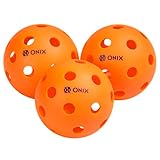
The ONIX Fuse Indoor is the most commonly recommended indoor ball — seamless heat-welded construction for durability, available in yellow and orange for visibility on different gym backgrounds, and a consistent bounce that holds up across sessions on smooth surfaces.
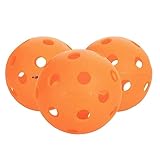
The Gamma Photon Indoor is the other widely used option, with high visibility yellow coloring and a reputation for consistent bounce on gym floors. Both balls are USAPA approved for indoor tournament play.

Last update on 2026-04-06 / Affiliate links / Images from Amazon Product Advertising API
How long do pickleball balls last?
This varies significantly by ball type, court surface, and how hard the game is. Standard outdoor balls typically last 3–10 sessions before cracking or losing their bounce — hard hitters on rough asphalt courts will be at the lower end of that range. Cold weather accelerates cracking on harder balls like the Dura Fast 40, which is why many players switch to the softer Franklin X-40 in winter.
Signs it’s time to replace a ball: visible cracks, a noticeably soft or “squishy” feel on contact, loss of true bounce (the ball bounces lower or erratically), or the ball has become out-of-round. Playing with a compromised ball changes the game feel and puts more stress on your paddle and arm.
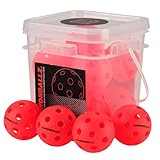
Buying balls in multi-packs is the most cost-effective approach for regular players. A 6-pack or 12-pack drops the per-ball cost significantly and means you’re never caught short at the court.


Last update on 2026-04-06 / Affiliate links / Images from Amazon Product Advertising API
Ball color — visibility matters more than you think
Yellow and neon green are the standard visibility colors for outdoor play — bright against most court backgrounds and sky conditions. Orange is popular for indoor play on darker gymnasium floors. White balls can disappear against bright backgrounds or overcast skies outdoors. When buying for outdoor use, yellow or neon green is the safe default. For indoor gym play, orange offers the best contrast against most flooring.
Pickleball equipment and structured training
The right ball is part of getting the most from your time on court — but technique, strategy, and physical conditioning are what drive real improvement. Our Dynamic Pickleball Club review covers one of the most popular app-based training programs for pickleball players who want to build their game with structure rather than just logging more court time.